Los Angeles County, California
Small handyman jobs in West Hollywood
West Hollywood packs about 34,400 people into 1.9 square miles, and roughly four in five households rent. Units are small, garages are rare, and almost nobody owns a stud finder. So the list here is short and specific: the TV, the shelves, the wall of anchor holes, the faucet that's been dripping since spring.
Best priceguaranteed
Fastand reliable
24/7available
10+experienced handymen
What goes on the list
The jobs, and what they look like done
Most visits are several of these at once. That is the whole economics of small work. The drive costs the same either way.
Nearly every job on the West Hollywood list ends in a wall. A TV bracket, a shelf, a curtain rail, a row of anchor holes filled before a walk-through. What decides whether it goes well is what that wall is made of, and in 1.9 square miles this city has three different answers. Send us the list and you’ll have a price for the visit before anything is scheduled.

The detail below is here if you want it. You do not need any of it to send us a job.
A city made of apartments, which changes the whole list
The city reports that 64% of residents live in apartments and that four out of five housing units sit in multi-family buildings, most of them holding somewhere between 4 and 20 units. Owner-occupancy is 19.8%. Put plainly, roughly four in five households here rent, and they rent something small.
That decides what people actually need done. Nobody is remodeling a kitchen in a one-bedroom off Harper Avenue. They need the TV off the floor, a shelf that holds books without tearing out of the plaster, a closet door that stops jumping its track, and a wall of anchor holes filled before the walk-through. Small, specific, and hard to get anyone out for. Two hours of work in a building with no parking is exactly the job that never gets a call back.
Our menu is twelve jobs long and it doesn’t grow. In 1.9 square miles of apartments, that turns out to cover most of what gets asked for.
Two eras of wall, sometimes on the same block
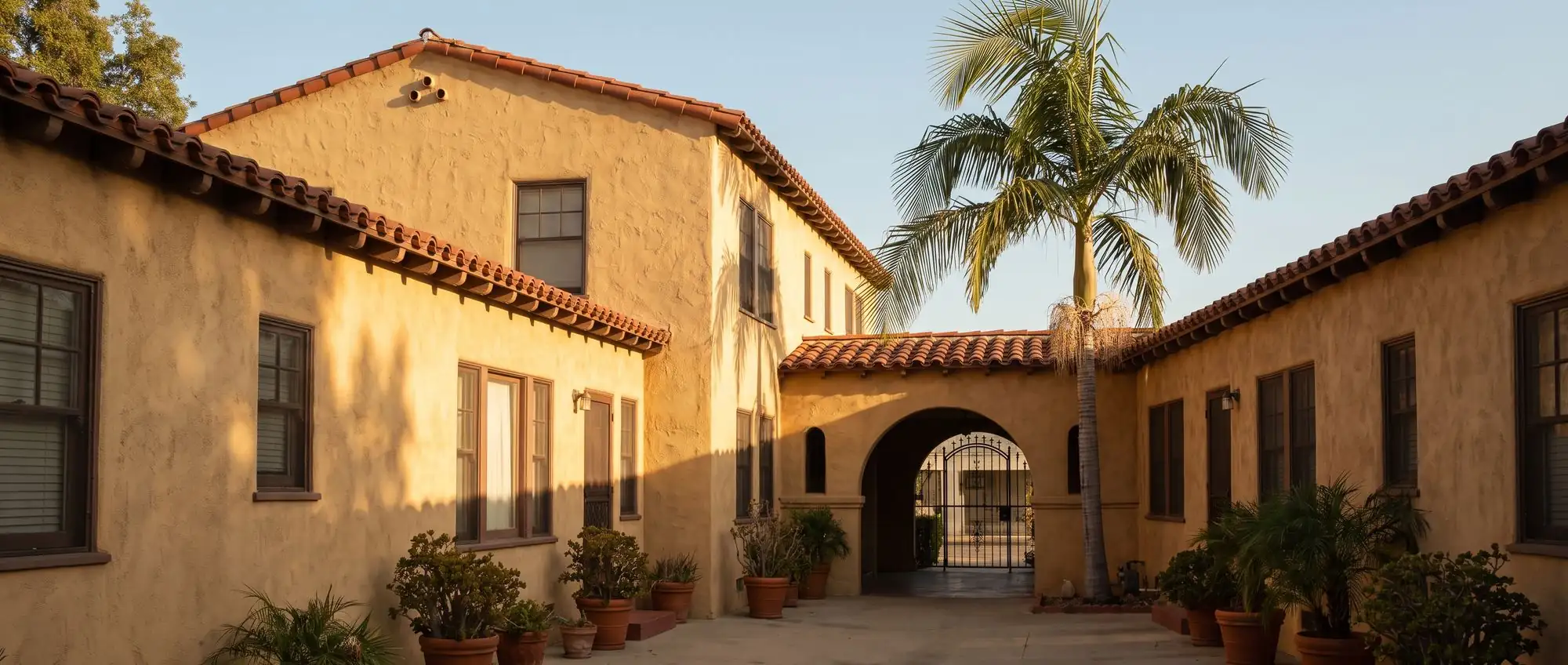
About 16.3% of the housing here was built before 1940. That’s the 1920s and 1930s Spanish courtyard apartments and bungalow courts concentrated around Havenhurst Drive, Harper Avenue, Sweetzer and the Fountain Avenue blocks. Arched openings, original tile, original hardware, and several of them landmarked. Those walls are plaster over wood lath, often with a hard-troweled or sand finish.
Plaster is brittle. It cracks if a bracket goes up in a hurry, the lath holds nothing on its own, studs sit at odd spacings, and old full-dimension lumber reads badly on a cheap stud finder. A patch here is also a different job from a drywall patch. Filling plaster with drywall compound alone tends to crack again inside a year, and matching a hand-troweled finish is done by eye on a test board. Our drywall repair page goes through that properly, and it applies to these buildings almost line for line.
Then the other half of the city: the 1950s, 1960s and 1970s garden apartment complexes and dingbats that fill much of the rest, including a lot of the blocks toward Kings Road and the Melrose and Beverly Boulevard edges. Those are drywall over wood studs, which is the easy case. A patch disappears, a bracket goes into a stud, and the price sits at the low end of every estimate on this site.
And a third layer newer than both: condo conversions and purpose-built condo buildings on the Sunset Strip side. Metal studs, and concrete in the taller ones. Each takes a different anchor, and the wrong anchor in a steel stud is one of the more common reasons a TV mount works loose a year later. If you’re not sure what your wall is, say “not sure”. It’s a normal answer and better than a guess.
The small houses in the Norma Triangle and in West Hollywood West near Doheny are the exception to all of this: actual single-family homes, with actual yards, gutters and gates. Gutter clearing and fence and gate repair make sense there and almost nowhere else in the city.
Renting, owning, or turning a unit over
West Hollywood is its own city with its own rent stabilization program, and that shows up in the work. Turnover jobs are a steady share of what gets asked for here. A batch of anchor holes filled and spot-painted, one room repainted, a tired faucet swapped, a closet door rehung between tenants. If you’re a landlord, a building manager or you’re turning a unit over, say so when you send the job in. It changes access, timing, and usually whether the whole list gets done in one visit between tenants.
If you rent, check what your lease actually lets you do. Mounting a TV puts holes in a wall; swapping a faucet changes a fixture that isn’t yours. Get the go-ahead first, in writing if you can.
If you own a condo, the HOA sets the rules, not a landlord, and most buildings here want a certificate of insurance from the pro before they’ll let them in. Ask your building what they need and tell us. It’s a normal request and a real pro won’t blink at it.
Getting in the door, with tools
This is the part that quietly decides whether a small job in West Hollywood goes well.
- Parking. There’s effectively none on the street in most of the city, and plenty of buildings run gated or valet garages. Tell us if there’s a spot, a loading zone, or nothing at all. Someone arriving with a drill, a ladder and a box of anchors needs to know before they set off, not after twenty minutes circling Havenhurst.
- Elevators. In the condo buildings, freight elevator use is often booked in windows. If your building has one, find out the hours and send them along with the job.
- Building approval. HOA sign-off and a certificate of insurance both take a few days to arrange. Starting that in parallel with getting a price is the difference between next week and next month.
- Neighbors. In a 12-unit building your walls are shared. Most of this work is quiet, but plaster demolition and hammer drilling into concrete are not, and the honest move is to plan them for mid-morning on a weekday.
Small units, so the fix is usually the wall
With no garage and no spare room, storage goes vertical. Wall-mounted shelving, floating shelves, a bracket that gets a 65-inch screen off a console it’s too big for, mirrors and curtain rails that make a small room read larger. On a plaster courtyard wall that’s also the cluster that goes wrong most often, because a floating shelf hangs its whole load off a hidden rod with no bracket helping.
The other steady one is fixtures and fans. A fixture swap in a 1960s garden apartment is simple. A ceiling fan isn’t automatically simple: a fan needs a fan-rated box fixed to framing or a brace, and a plain lighting box is the usual reason an install stops halfway through. In the pre-war buildings you may also find two wires and no ground, and old cloth wiring or knob-and-tube is a stop-and-get-an-electrician moment, not something to work around.
Same on the plumbing side. Faucet, toilet and disposal replacement is a like-for-like swap where the supply lines are already there. On the older stock the surprise is nearly always the same one: a seized shut-off valve that won’t turn. That’s an add-on, not a disaster, and a good pro tells you before touching it.
Doors round out the list. Buildings settle, and eighty-year-old ones have had time to. A door that catches is usually the frame moving, not the door being wrong, which is why planing the edge is the wrong first move most of the time. Bifold and closet doors in these units come off their track constantly and are a twenty-minute fix.
When you need a licensed contractor, and the West Hollywood twist on it
California law has a minor work exemption, Business and Professions Code section 7048, that lets some small jobs be done without a CSLB contractor license. There’s no single price that settles it. The exemption applies only when the work is casual, minor or inconsequential, the total for labor and materials comes to less than $1,000, and the job needs no building permit. Splitting a bigger job into smaller contracts to get under that number doesn’t count, and neither does work that’s part of a larger project. The exemption is also withdrawn from anyone who advertises in a way that might suggest to the public they’re a contractor, or who brings in another person to help with the work. Miss one condition and a license is required. Most of what’s described on this page is small work, but price is only one of the conditions.
Here’s the local wrinkle. When a job needs a licensed contractor, and possibly a permit, West Hollywood is its own city with its own Building and Safety division. It is not the City of LA’s process, and a pro who works mostly on the other side of Fairfax or La Cienega may not have dealt with it. Worth saying up front if your job might be big enough to need one.
One useful trick, since so much of the demand here is fixture swaps: the price of the fixture counts toward the total. Buying your own faucet or toilet and having the pro fit it keeps more jobs under $1,000 than people expect.
Knowing those conditions tells you more about who you’re dealing with than any badge on a website does. If a job turns out to need a licensed contractor once someone has seen it, they should stop and say so before going any further.
Pre-1978 paint, which is most of this city
Buildings put up before 1978 may have lead-based paint, and sanding or cutting into a painted surface is exactly what disturbs it. Given the age of the stock here, that covers a large share of West Hollywood. For work disturbing painted surfaces in a pre-1978 building, the federal RRP rule requires a certified renovator using contained work practices once the job disturbs more than six square feet of painted surface in a room, or twenty outside. Mention the build era when you send the job in. In a pre-1978 building it decides who is allowed to open up a painted surface at all.
What isn’t handyman work here
Saying no to things is more useful than claiming everything.
- Anything electrical past a fixture swap. A new outlet behind the TV, new circuits, panel work. Licensed electrician.
- Plumbing past a like-for-like swap. Re-pipes, slab leaks, opening a wall. Licensed plumber, and in a multi-family building that’s usually a conversation with the HOA or the owner first anyway.
- Roofing, structural work, HVAC, permits, whole-building repaints and remodels. Real trades, none of them a two-hour visit.
- Common-area work. If the problem is in a hallway, a courtyard or a garage, that’s the building’s job and the building’s contractor, not something an individual resident should be booking.
Sending a West Hollywood job in
A rough description is plenty, and if you have a photo on your phone, have it to hand for the call back. It settles more than anything you can type. Beyond that, the four things worth telling us are your cross streets, roughly when the building went up, whether you rent or own, and what the parking situation is. That’s enough to price it accurately.
West Hollywood jobs usually get scheduled the same working day, or the next morning if the list comes in during the evening or over the weekend. You can see how the rest of the county breaks down on our areas page, or just send the list in.
You get a price for the visit before anything is scheduled, and the small stuff bundled into one trip instead of four separate ones.
Where we work
The rest of Los Angeles County
What the walls are made of changes street by street in this city, and it changes the job.

Send us the list
However long it is. You get a price for the visit before anything is booked.