Skip to content
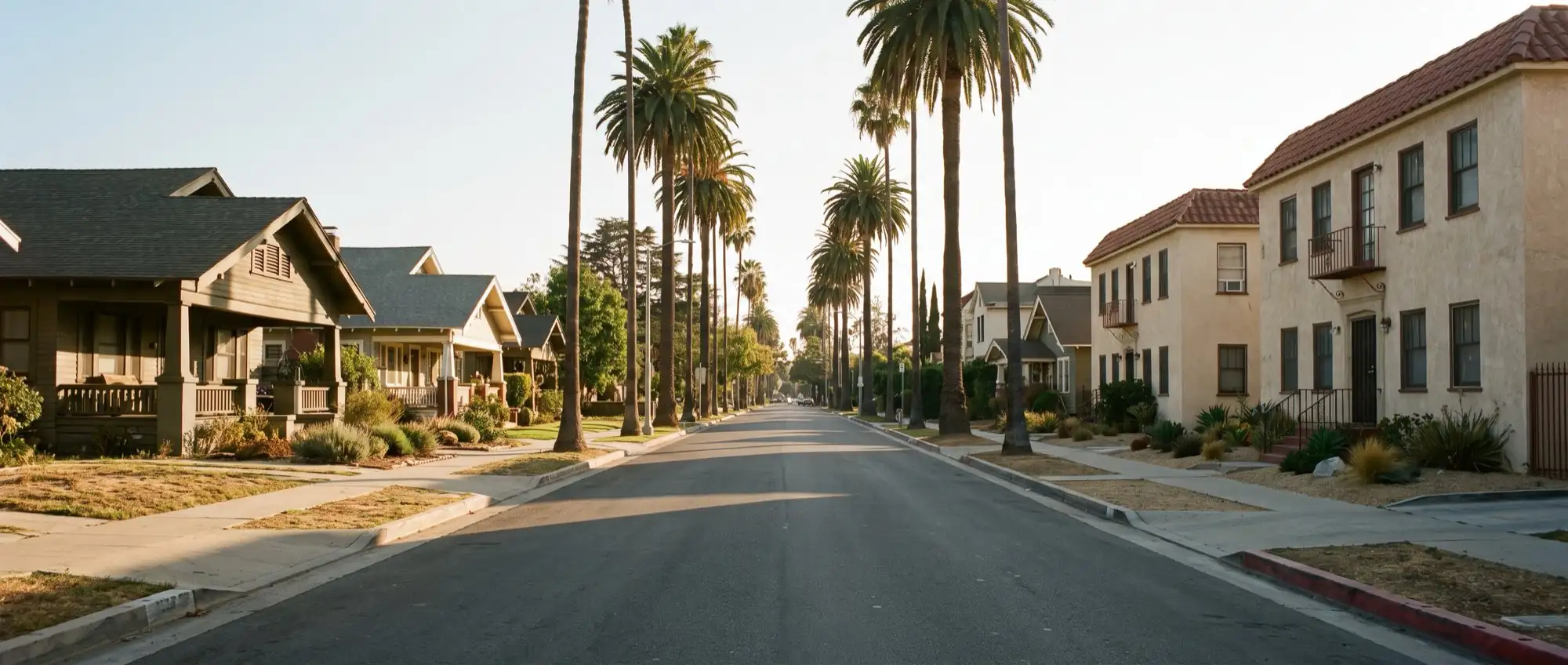
A residential street of older Los Angeles bungalows in afternoon light

Los Angeles County, California

Small handyman jobs in Panorama City

Panorama City splits at Van Nuys Boulevard. East of it, the Valley's first postwar tract: over 4,000 near-identical Kaiser houses from 1948. West of it, sixty years of stucco apartments. Same neighborhood, two completely different walls, and knowing which one you're standing in front of is half the job.

Best priceguaranteed

Fastand reliable

24/7available

10+experienced handymen

Small repairs, installs and the odd-jobs list in Panorama City. The TV that needs mounting, the door that won’t latch, the batch of holes the last tenant left behind. Tell us what’s on the list and which side of Van Nuys Boulevard you’re on, and you’ll have a price agreed before any work is scheduled.

About 62,653 people live here, in one of the denser corridors in the middle of the Valley, and most of them rent. What decides your job, though, is the boulevard.

A driver going into a door hinge, one hand steadying the door
Detached houses of this era have had decades to settle, so the opening moved and the door did not. Most of the time that is a hinge, not a new door.

The detail below is here if you want it. You do not need any of it to send us a job.

The neighborhood splits at Van Nuys Boulevard

Single-family houses fill the streets east of Van Nuys Boulevard. The western side is largely apartments. One street, two build eras. Different walls on each side, and a different kind of customer. You can check it on any map in about ten seconds, and it tells you more about what your job costs than anything else on this page.

So the first thing we want to know about a Panorama City job is which side of the boulevard you’re on.

East of the boulevard: the Kaiser tract

Panorama City was the San Fernando Valley’s first postwar planned community, developed from 1948 by Fritz B. Burns and Henry J. Kaiser. The master plan, by the architects Wurdeman and Becket, called for over 4,000 houses, with thirty-one acres set aside for commercial use and twenty-five for parking. The houses were largely pre-milled and shop-fabricated by Kaiser shipbuilders at a factory near LAX, then trucked out and assembled on site in Ranch and Minimal Traditional styles, for under $10,000 each.

Here’s why that matters when someone is standing in your living room with a drill: the houses on your block are your house. Same stud layout. Same door sizes. Same ceiling heights. Same original hardware, where it hasn’t been swapped out. Someone who has hung a door or patched a wall two streets over has already done yours, near enough, and can tell you over the phone what to expect behind the paint. That is not true anywhere else in this county, and it’s the single best reason to say “Kaiser tract, east of Van Nuys” when you send a job in.

The wall itself is a late-1940s wall, which means rock lath with a plaster skim coat shows up all through this stock. It looks like drywall until somebody drills. It’s harder, it’s a little deeper, a screw bites differently, and a hole saw wants to wander. For a patch it means building the repair up to the right depth instead of setting a board flush and hoping nobody looks at it in side light. Not difficult work. Just different, and slower than the drywall version. A quote given blind over the phone by someone who’s never worked the tract tends to be wrong.

West of the boulevard: the apartment belt

West of Van Nuys Boulevard, and along Roscoe, Nordhoff and Parthenia, it’s 1960s and 1970s stucco apartment blocks and dingbats. Those are drywall over wood studs. That’s the easy case, the wall the internet assumes you have, and it sits at the low end of every estimate on our what things cost page. Studs read cleanly, anchors behave, a patch takes compound and texture and disappears. A standard TV mount on a drywall stud wall runs roughly $150 to $300 in labor over here, against the $250 to $450 range you’d expect on plaster, brick, concrete or steel stud.

Which brings up the third case. The newer affordable and mixed-income buildings that have gone up along Van Nuys Boulevard are metal stud, not wood. Nothing wrong with metal stud, but it takes its own anchor, and the wrong anchor in a steel stud is the classic reason a mount that felt solid on the day works loose a year later. If you’re in a building that went up in the last fifteen or twenty years, say so. It changes the hardware, not the price.

Ceiling fans are the summer job here

This is the Valley. Ceiling fans and light fixtures are the summer job in Panorama City the way gutters are the fall job, and the calls start stacking up around May.

Two local wrinkles before you buy a fan.

The first is the box in the ceiling, and it’s the single most common reason a fan install stops halfway. A fan has to hang from a box rated for fan support, fixed to framing or to a brace between joists. A plain lighting box will not do, however well the screws go in. In 1940s and 50s ceilings, a plain lighting box is usually what’s up there: the old fixture comes down, and the box behind it has to be replaced before anything else happens. That’s the difference between a fan replacing a fan, roughly $150 to $300, and a new fan where a light fixture was with the box replacement included, roughly $250 to $450.

The second is specific to the Kaiser houses. A lot of them have picked up a slab-on-grade addition out the back over the years, and those additions often have no attic access above them. In the original part of the house, with attic above, replacing that box is straightforward. In the addition, it can mean opening a small patch of ceiling and repairing it after. Have a look before you decide which room the fan goes in.

If a box comes open and there are two wires and no ground, or old cloth-covered insulation crumbling off the conductors, that’s a stop-and-tell-you moment. Nobody should twist it back together and walk away. In ceilings this age it turns up often enough to expect it, and it’s work for a licensed electrician, not part of a fixture swap.

Renting, owning, or turning a unit over

Most of the apartment stock west of the boulevard falls under the City of LA rent stabilization ordinance, which covers two or more units with a certificate of occupancy on or before October 1, 1978. That describes almost everything built here in the sixties and seventies. It means steady between-tenant turnover work, and a real share of what comes in from this part of the Valley.

  • Tenants. Get your landlord’s or manager’s yes in writing before anything goes into a wall, especially a TV mount or a curtain rail. Say you’re renting when you get in touch, so we keep the work reversible and can tell you up front what the patch looks like when it comes back down.
  • Owners east of the boulevard. You own the roofline, the fence and the gate, which puts a few more jobs on your list than an apartment tenant has. And if your street is Kaiser tract, mention it.
  • Landlords and unit managers. Turnover work comes as a batch, not a single item: a batch of nail and anchor holes at roughly $150 to $300 for the visit, a doorknob-sized hole textured and painted at roughly $200 to $400, a bifold rehung, a tired faucet swapped, one room painted. Say you’re turning a unit when you write in, and send the whole list at once. A punch list priced as one visit costs less than the same items booked one at a time.

Either way, find out early whether the building wants written permission or a certificate of insurance on file before anyone with tools comes through the gate. That’s much easier to sort out ahead of the visit than on the morning of it.

Parking, access, and why it pays to batch

West of the boulevard it’s apartment parking: permit blocks, tuck-under carports with every space spoken for, and a lot of circling. East of it there are driveways, which is easier, but the streets are narrow and the tract garages are small. Someone arriving with a ladder, a hammer drill and a toilet to haul out has real overhead before they’ve touched anything.

That’s why one nail hole is a hard thing to book anywhere, and why the fix is always the same. Walk the place and write down everything. The TV, the two curtain rails, the mirror in the hall, the bathroom door that won’t latch, the holes the last tenant left. Send it as one job. One visit, one price.

Tell us about the access too: a gate, a garage with a height limit, a second-floor walk-up with no elevator. None of it is a dealbreaker. All of it changes how long the visit takes.

The jobs that come up most around here

  • TV mounting and wall shelving. The most common ask on both sides of the boulevard, and the one most affected by whether there’s drywall, rock lath or steel stud behind you.
  • Drywall and plaster repair. Anchor holes in a batch, doorknob holes, and rock-lath patches in the tract that need building up to depth. Texture matching is the hard half, not the filling.
  • Interior door repair and adjustment. Seventy-odd years of settling does the same thing here it does everywhere: the door is still a rectangle, the opening isn’t. Rubbing at the top of the latch side usually means a sagged top hinge, not a door that needs planing. In the tract, the good news is that the doors are all the same doors.
  • Faucet, toilet and disposal swaps. Like-for-like only. On anything original, expect the angle stop behind the fixture to be seized. It’s the single most common surprise on older LA plumbing, and adds roughly $75 to $150 per valve.
  • Ceiling fans and light fixtures. See above. Check what’s rated to hold the thing before you buy it.
  • Gutter clearing. An east-of-the-boulevard job, mostly. Rain season runs roughly October through March, so book it in September, not the first wet week of November. If you’re a tenant three floors up on the west side, the gutters are the building’s problem and not yours.
  • Fence and gate repair, small carpentry, flat-pack assembly, weatherstripping and small painting. Fences and gates are owner-side, so they’re an east-side job too.
  • Floor repair. The tract houses sit on slab, so the squeak over dried-out joists that runs through most older LA stock is not the job here, though upstairs in the dingbats, where there is framing under you, it is. What comes in from both sides of the boulevard is laminate and vinyl plank lifting at the seams on a ground floor, roughly $300 to $850, and thresholds and transition strips worn loose over a run of turnovers. If there is 9x9 tile with black mastic under the current floor, that is an asbestos suspect in stock this old, and it stops the job instead of starting one.
  • Grab bars and home safety. The Kaiser houses are single-story, so for an owner staying put the ask is the bathroom and not a stair rail. Behind an original tub it is rock lath and plaster, often with mud-set tile over it, so the bar has to land on a stud or on blocking and never on an anchor pushed into plaster: roughly $225 to $450 for the first bar, $325 to $650 where it goes through mud-set tile. West of the boulevard, a turnover is the time to sort the alarms, and California requires a CO alarm in any unit with a gas appliance or an attached garage.

Lead paint, because almost all of this is pre-1978

The Kaiser houses are 1948 onward and the apartment belt is largely sixties and seventies, so the whole neighborhood sits on the wrong side of 1978. Homes built before then may have lead-based paint, and for work that disturbs painted surfaces the federal RRP rule requires a certified renovator using contained work practices once the job disturbs more than six square feet of painted surface in a room, or twenty outside. Sanding an old door and jamb, or cutting into a painted wall for a patch, is the kind of work that triggers it. Tell us roughly when the building went up, and say if the paint underneath looks original. That’s the difference between a straightforward patch and a contained job done by a certified renovator. Better to know before the sanding starts.

How narrow the license exemption is

California has a narrow exemption for small jobs, in Business and Professions Code section 7048. It covers work that is casual, minor or inconsequential, where the whole contract comes to less than $1,000 counting labor, materials and everything else, and where the work doesn’t require a building permit. The job can’t be split into smaller contracts to get under the number, and it can’t be one piece of a larger project. The exemption also drops away for anyone who advertises or puts out a sign or card that might suggest to the public they’re a contractor, or who brings in another person to do or help with the work. So there is no simple price line here, and anyone who tells you there is one is giving you a rule that doesn’t exist. Where a job needs a licensed contractor, that is who should be doing it, and not the same person with a bigger invoice.

Almost everything above is small enough to be in that territory on price. Some Panorama City jobs plainly aren’t: a whole unit repainted between tenants, several tract doors replaced at once, a run of gutter replaced instead of resealed. And price isn’t the only test. Anything that needs a building permit is outside the exemption whatever it costs. On fixture jobs, remember the price of the fixture counts toward the total, so buying the toilet or the faucet yourself is often what keeps a job under $1,000. And if the work grows once someone has had a proper look at it, we’ll stop and tell you before anything else happens.

What we won’t take on here

Saying no to things is more useful than claiming everything.

  • Electrical past a fixture swap. New circuits, a new outlet behind the TV, panel work. Licensed electrician.
  • Plumbing past a like-for-like swap. Re-pipes, slab leaks, anything that opens a wall. In a slab-on-grade tract house that comes up more than you’d like.
  • Roofing, structural work, permits, HVAC, tree work, whole-house repaints and remodels. Real trades, none of them a two-hour visit.
  • Sanding or disturbing paint in a pre-1978 home without a certified renovator. Which, around here, means essentially every home.
  • Building-wide maintenance contracts. One address, one visit, one agreed price. Standing maintenance across a whole portfolio of buildings is a bigger job than anything described here.

If your job is on that list, send it in anyway and say so. Knowing the right trade on day one is worth more than a cheap visit from the wrong one.

What to tell us when you get in touch

  • Your cross streets, and which side of Van Nuys Boulevard you’re on. It’s the fastest way to tell us what your walls are.
  • Roughly when the place was built, or just what it looks like: tract house, stucco apartment block, newer building on the boulevard.
  • What the wall is, if you know. Drywall, rock lath and plaster, or metal stud. Not sure is a fine answer.
  • Whether you rent, own or manage the unit, and who needs to approve the work.
  • Parking and access.
  • A photo. It saves more back-and-forth than anything you can type.

That’s enough to price a visit properly. Send us the list and you’ll get an answer on your Panorama City job, usually the same working day, with the price for the visit settled before anything is scheduled. Typical ranges for the jobs above are on the what things cost page, and the rest of the Valley is on the areas page.

One visit, a price agreed before the work starts, and the whole list off your kitchen counter.

Where we work

The rest of Los Angeles County

What the walls are made of changes street by street in this city, and it changes the job.

Send us the list

However long it is. You get a price for the visit before anything is booked.

Send the listCall