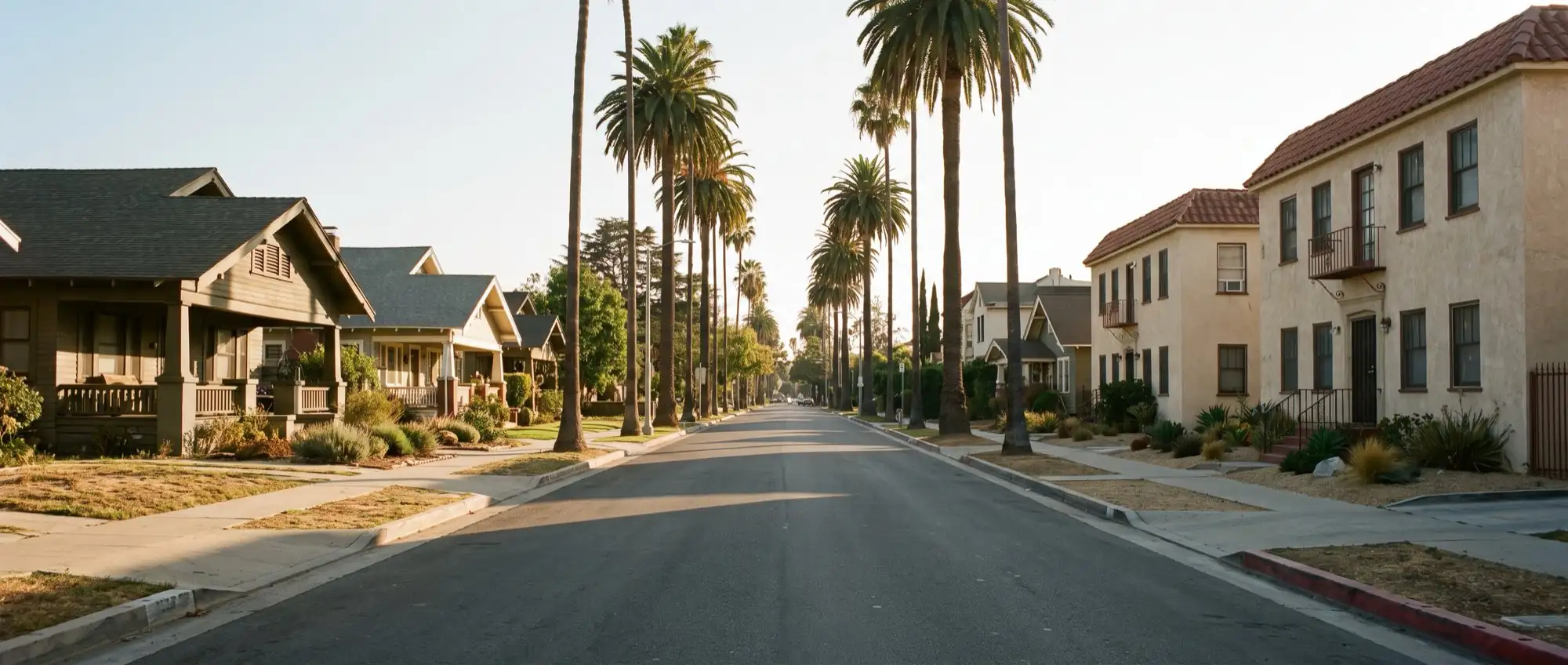
Los Angeles County, California
Small handyman jobs in Glendale
Adams Hill plaster, the sixties apartment belt along Central and Glenoaks, the canyon houses above Chevy Chase. About 64.8 percent of Glendale rents, and roughly 8,262 of those rentals went up in a single decade. The same short list of small jobs, three very different walls behind the paint.
Best priceguaranteed
Fastand reliable
24/7available
10+experienced handymen
What goes on the list
The jobs, and what they look like done
Most visits are several of these at once. That is the whole economics of small work. The drive costs the same either way.
Small jobs in Glendale, with the price agreed before anything starts. A TV on the wall, a door that won’t latch, a batch of anchor holes filled and painted, a tired faucet swapped out. It’s the list most people put off, because nobody wants to book a whole trade for two hours of work. Bundle them into one visit and that problem goes away.
Glendale rents more than it owns. About 64.8 percent of occupied homes here are rented, and the biggest single block of that housing is older than most people assume. Roughly 8,262 apartment units went up between 1960 and 1969, about 17 percent of every rental in the city. One decade, one construction style, tens of thousands of people living in it. Working small jobs here, we can spend a whole week in more or less the same wall.
A two-hour job is worth the trip in Glendale in a way it isn’t out in the spread-out parts of the county. The next call is usually eight blocks away.

The detail below is here if you want it. You do not need any of it to send us a job.
Three kinds of wall, and the sixties belt is most of it
The 1960s apartment belt
The garden apartments and stucco boxes along Central, Glenoaks, Kenneth and the Verdugo corridor are the easy case, and there are a lot of them. Drywall over wood studs, standard spacings, anchors that behave. A stud finder reads honestly. A patch takes compound and texture and disappears. If you live in one of these, most of the job list is priceable close to sight-unseen, and you’ll sit at the low end of every estimate on the what things cost page. A TV mount on drywall studs runs about $150–300, a batch of nail and anchor holes about $150–300 for the visit.
The thing to watch in this stock is the ceiling. A fan has to hang from a box rated for fan support, and a plain lighting box will not do however well the screws go in. In a second-floor unit with a neighbor above, replacing that box can mean opening a small patch of ceiling and repairing it after.
The pre-war blocks: Adams Hill, Rossmoyne, Vista del Valle
The 1920s Spanish and Craftsman houses on these streets are a completely different wall. Plaster over wood lath: harder, deeper and more brittle than drywall, it blows out in a cone if a mount is rushed, and the lath holds nothing on its own. Studs sit at irregular spacings, and old full-dimension lumber reads badly on a cheap stud finder, which is how a bracket ends up anchored to air. We go looking for real framing instead of trusting a beep, and we’ll often span two studs with a longer plate. Mounting on plaster and lath runs more like $250–450 for that reason.
These houses have also had a century to settle. Frames that were square in 1926 aren’t square now, so the doors catch at the top of the latch side or need a shove to land. Usually that’s a sagged top hinge, not a door that needs planing, and the door repair page covers what to look at first. Patching plaster with drywall compound alone tends to crack again inside a year, because the plaster around it keeps moving. Plaster repair is its own job, priced above the drywall repair equivalent, and we tell you that before we start.
Downtown: the mid-rise and podium buildings around Brand and Central
The newer apartments and condos in the downtown core are metal studs and concrete. Neither is a problem, but each takes its own anchor, and the wrong anchor in a steel stud is the most common reason a mount works loose a year later. Concrete needs the right bit and the right sleeve. If the building has a post-tension slab, drilling into it is a stop-and-ask, not a judgment call made on the spot. Tell us which kind of building you’re in when you send the job over. It changes the hardware and it changes the time.
Renting, owning, or turning a unit over
With nearly two thirds of Glendale renting, most jobs here come from one of three people, and each needs something slightly different.
- Tenants. Get your landlord’s or manager’s yes in writing before anything goes into a wall, especially a TV mount or a curtain rail. Say in your message that you’re renting, so we keep the work reversible and can tell you up front what the patch will cost at move-out.
- Owners with an HOA. The downtown condos and the newer podium buildings usually have rules about work hours, elevator booking and certificates of insurance. Mention the HOA when you get in touch. None of that is a problem. It just makes the booking a different shape.
- Landlords and managers. A sixties apartment belt that size means steady turnover work: a wall of anchor holes filled, a doorknob-sized hole textured and painted, a tired faucet swapped, a bifold put back on its track before the next tenant walks in. Say you’re turning a unit, and say how many items are on the list. Punch-list work runs on a different clock than one careful install in an occupied home, and the price for the visit reflects that.
Glendale wrote failure-to-repair into its tenant law
This is the part that makes Glendale unusual. The city’s Rental Rights Program, Ordinance 5922, took effect on March 14, 2019 and was updated effective March 7, 2024. It sits in chapter 9.30 of the Glendale Municipal Code, and it has five components: just cause eviction, relocation assistance, right to lease, rent reduction, and intentional disrepair.
That last one is why it belongs on a handyman page. Glendale has written letting a unit fall apart into its tenant law, with temporary relocation attached when a unit becomes unlivable. So owners and managers here have a real reason to get repairs done properly, done by someone competent, and to keep a record of it.
The relocation piece has a date on it that’s easy to get wrong. It applies to buildings of three or more units with a certificate of occupancy before February 1, 1995, and it’s triggered when a tenant moves out in response to a rent increase above 7 percent in a twelve-month period. Note that date. It is not the October 1, 1978 line people quote from the City of LA’s rent stabilization ordinance. If the details matter to your situation, check them with the city’s program and not with a handyman.
The power and water are the city’s, not LADWP’s
Small thing, but it saves a phone call. Glendale Water & Power is owned by the City of Glendale, administered by the GWP Commission and governed by the city council. Roughly 85,000 electric accounts and about 34,000 water accounts. Not LADWP, not Edison. So when a light fixture job turns out to be a service problem, or a leak turns out to be on the utility’s side of the meter, the number you want is the city’s, not the one your friends in LA use.
The hillside houses are a different city
Chevy Chase Canyon, Verdugo Woodlands and Whiting Woods are real single-family houses with yards, gates, fences and gutters. That’s the only part of Glendale where gutter clearing, fence repair and gate repair make much sense, and up there they matter a lot. Oak and eucalyptus drop a heavy, gritty leaf load, and gutters full of that don’t drain, they hold water. Rain season runs roughly October through March, so the window to book is September, not the first wet week of November. By then everyone in the county has had the same idea at once.
These are also narrow hillside streets, often with a steep driveway and nowhere to leave a van. A ladder long enough for a two-story fascia needs somewhere to go. Say up front if access is tight, if there’s a gate, or if the only parking is on a grade. None of that is a dealbreaker. It just changes how long the visit takes.
The jobs that come up most around here
- TV mounting and wall shelving. The most common ask in a city that mostly rents, and the one most affected by whether you’ve got drywall, plaster or steel stud behind you.
- Drywall and plaster repair. Anchor holes in a batch, doorknob holes, hairline cracking in the pre-war houses. Texture matching is the hard half, not the filling.
- Interior door repair and adjustment. Settled frames in Adams Hill and Rossmoyne, closet bifolds off their track in the sixties apartments.
- Ceiling fans and light fixtures. Swaps where a box and wiring already exist. In the pre-war houses it’s common to find two wires and no ground, and old cloth wiring or knob-and-tube is a stop-and-call-an-electrician moment.
- Faucet, toilet and disposal swaps. Like-for-like only. On anything sixty years old that’s never been touched, expect the angle stop behind the fixture to be seized. It’s the single most common surprise on older LA plumbing, and we carry the valve.
- Picture, mirror and curtain hanging, flat-pack assembly, small carpentry, weatherstripping and caulking, small painting jobs. The everyday list, and the one that batches well.
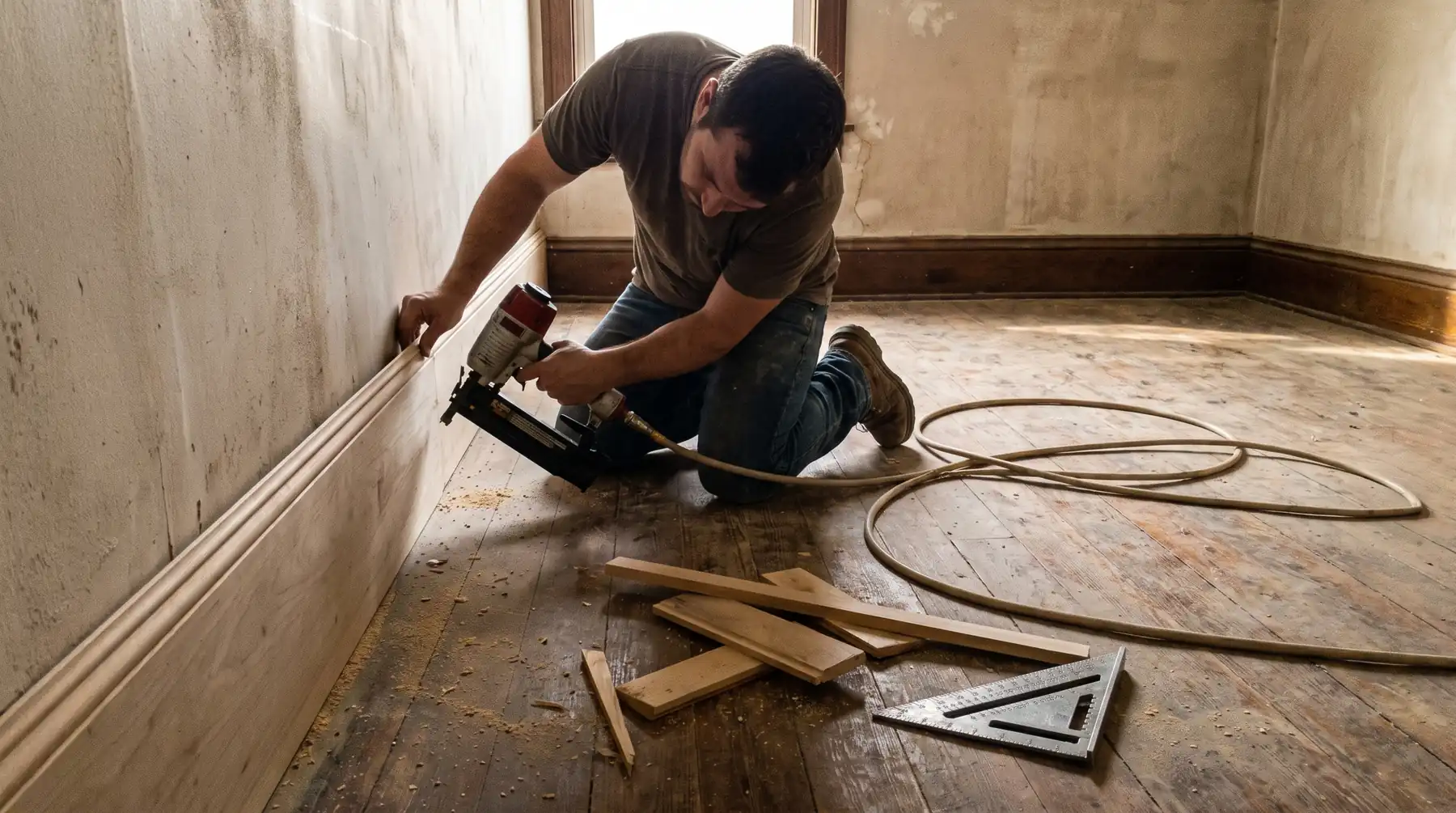
- Floor repair, squeaks and lifting planks. In the sixties apartment belt it is usually laminate or vinyl plank lifting at the seams in a ground-floor unit where the slab under it wicks damp, plus thresholds worn through after a few tenancies. The oak strip in the Adams Hill and Rossmoyne houses was laid over joists and has had a century to dry and shrink, so the squeak is a board loose at its fastening, reachable from above without pulling the floor up. One caution in the older buildings: nine-inch vinyl tile and the black mastic under it is an asbestos suspect, and that goes to a licensed abatement contractor.
- Grab bars, handrails and home safety. The pre-war bathrooms in Rossmoyne and Vista del Valle are mud-set tile over wire lath, which holds a bar well but takes a slower method and the right bit, and the bar still has to land in framing or solid blocking behind it. Up in Chevy Chase Canyon and Whiting Woods the ask is more often a rail on an exterior stair run that turns slick from October through March, or a second handrail in a two-story house someone means to stay in. California requires a water heater to be strapped against earthquake movement, and in the sixties buildings it is often unstrapped in a hallway closet.
That last point is the one to act on. Walk the place and write down everything: the TV, the curtain rails, the hallway mirror, the bathroom door that won’t latch, the anchor holes from last year. Send it as one job. One visit, one price, and it stops being an awkward ask.
Pre-1978 paint, which is a lot of Glendale
Homes built before 1978 may have lead-based paint, and that covers the pre-war blocks and much of the 1950s stock here. For work that disturbs painted surfaces, the federal RRP rule requires a certified renovator using contained work practices once the job disturbs more than six square feet of painted surface in a room, or twenty outside. Sanding an old door and jamb, or cutting into a painted plaster wall for a patch, is the sort of work that triggers it. Tell us roughly when the building went up. On a pre-1978 wall that one detail decides the whole method. Either the job goes to a certified renovator working with containment, or somebody runs a sander and spreads lead dust through the room.
What the license rule says
California has a narrow exemption for small jobs. It’s the minor work exemption, Business and Professions Code section 7048. It only covers work that’s casual, minor or inconsequential, where the whole contract price for labor, materials and everything else comes to less than $1,000, and where no building permit is needed. The job also can’t be part of a larger project, and it can’t be split into smaller contracts to get under the number. On top of that, the exemption doesn’t apply to someone who advertises in a way that might suggest to the public they’re a contractor, or who brings another person along to do or help with the work. So there’s no single clean price line to check. The number is one condition out of several, and a job that misses any of them needs a licensed contractor.
Nearly everything above is small work that sits well under $1,000, but the price is only the first thing to check. Some Glendale jobs go well past it: a whole unit repainted between tenants, several doors replaced at once, a run of hillside gutter replaced instead of cleared and resealed. When a job runs past $1,000, or needs a permit, or is one piece of a bigger project, it belongs with a licensed contractor, and we’ll tell you that up front. Not the same job with a bigger invoice. On fixture jobs the fixture price counts toward the total, so buying the faucet or the toilet yourself is often what keeps the total under $1,000. And if a job grows once we’ve seen it, we stop and say so before going further, at no cost to you.
What we won’t take on in Glendale
Saying no to things is more useful than claiming everything.
- Electrical past a fixture swap. New circuits, a new outlet behind the TV, panel work, a breaker that keeps tripping. Licensed electrician.
- Plumbing past a like-for-like swap. Re-pipes, slab leaks, anything that opens a wall or touches a shared line in a stacked building.
- Roofing, structural work, permits, HVAC, tree work, whole-house repaints and remodels. Real trades, none of them a two-hour visit. In the canyons, tree work in particular is its own licensed job.
- Sanding or disturbing paint in a pre-1978 home without a certified renovator. Lead rules apply, and they aren’t optional.
- Building-wide maintenance contracts. This is per-job work. One address, one visit, one price agreed in advance. Ongoing maintenance across a portfolio of buildings needs a different arrangement.
If your job is on that list, send it anyway and say so. Being pointed at the trade you need is worth more than being told yes to something that was never a two-hour visit. And if we can’t take a job on in your part of Glendale, you’ll hear that within about a day, with the reason, same as anywhere else in the county.
What to tell us when you get in touch
- Your cross streets. Kenneth and Glenoaks is a different job from Chevy Chase Canyon. Different wall, different parking, and up in the canyon a much longer ladder. Glendale is not one place, and “LA” tells nobody anything.
- Roughly when the building went up, or just what it looks like: pre-war house, sixties garden apartment, or downtown mid-rise.
- What the wall is, if you know. Drywall, plaster, concrete, steel stud. Not sure is a fine answer.
- Whether you rent, own or manage the unit, and whether there’s an HOA, a landlord or a manager who needs to approve the work.
- Parking and access, including a steep driveway, a gate, or an elevator that needs booking.
- A photo. It saves more back-and-forth than anything you can type.
That’s enough to price the visit properly. Send us the list and you get a clear price before any work starts, and nothing to pay for asking. Send the whole walk-around list in one go, not just the one job that finally annoyed you. That is what turns an afternoon of awkward small asks into a single visit with a single price. Pricing and scheduling are set out on the how it works page.
Where we work
The rest of Los Angeles County
What the walls are made of changes street by street in this city, and it changes the job.

Send us the list
However long it is. You get a price for the visit before anything is booked.