Los Angeles County, California
Small handyman jobs in North Hollywood
North Hollywood is mostly renters, about three quarters of the roughly 31,000 occupied homes here. That changes the list. Less deck rebuilding, more mounting a TV without wrecking the wall, a door that stopped latching, and a wall of anchor holes to fill before the walkthrough.
Best priceguaranteed
Fastand reliable
24/7available
10+experienced handymen
What goes on the list
The jobs, and what they look like done
Most visits are several of these at once. That is the whole economics of small work. The drive costs the same either way.
Small jobs in North Hollywood come down to three things: what’s behind the wall, what the building lets you do, and where a van can park within carrying distance. Those change block by block here, and they’re the difference between an hour and half a day.

The detail below is here if you want it. You do not need any of it to send us a job.
What the walls are made of here
This is the first thing that matters, because it decides whether a TV mount takes an hour or three.
North Hollywood’s median home was built in 1968, and most of the housing went up between 1940 and 1969. That’s a different wall from the ones in the older parts of town. Postwar tract houses came first, then wave after wave of 1950s and 1960s garden apartments and dingbats along Lankershim, Magnolia, Burbank Boulevard, Victory and Vineland. In that stock you’re usually looking at drywall over wood studs, which is the easiest wall in Los Angeles to hang something on. Studs read cleanly, anchors behave, a patch takes compound and texture and disappears.
Three exceptions come up often enough to name.
1940s and early 1950s houses often have rock lath with a plaster skim coat. It looks like drywall until somebody drills. It’s harder, it’s slightly deeper, a screw bites differently, and a hole saw wants to wander. For a patch it means building the repair up to the right depth instead of setting a board flush and hoping. Most of the single-family streets behind the boulevards fall in this era, so it comes up a lot.
The pre-war pockets are true plaster over wood lath. There are 1920s and 1930s bungalows still standing near Lankershim and around Camarillo, and those walls are brittle, crack if they’re rushed, and the lath behind them holds nothing on its own. Studs sit at odd spacings, old full-dimension lumber reads badly on a cheap stud finder, and a pro will often span two studs with a longer plate instead of trusting one. Plaster repair is also a different job from drywall repair. Patch it with drywall compound alone and it tends to crack again inside a year.
The new buildings near the station are a third case. The podium and mid-rise apartments and condos that went up around the NoHo station and the arts district from the 2000s onward tend to have steel studs, and some walls are concrete. Each takes its own anchor, and the wrong anchor in a steel stud is one of the most common reasons a mount works loose six months later. If you’re in one of those buildings, say so. It changes the hardware and the time.
If you don’t know which of those you have, that’s fine. Tap the wall, tell us the year the building went up, and send a photo. That’s usually enough to work out what’s behind it and price the job properly.
Most of North Hollywood rents, and that changes the job
About 75% of the roughly 31,000 occupied homes here are rented, against about 25% owned. Owner-occupancy sits in the single-family tracts; the corridors are apartments. It’s the densest rental market in the Valley.
What that means in practice: shorter tenancies, more moving in and out, more furnished and short-let units near the arts district, and a steady run of the same four or five jobs. TV mounting in a unit you don’t own. Flat-pack assembly the weekend after a move. Curtain rails and mirrors. A batch of anchor holes filled and painted before a walkthrough. Small painting and touch-ups between tenants.
If you’re renting, get the landlord’s yes in writing before anything goes into a wall, and ask what they expect back at the end. A good pro can tell you where the bracket will land and what the patch looks like when it comes down. Have that conversation before the drill comes out. If you own a condo near the station, the HOA usually has its own rules about drilling hours and common walls.
If you’re the landlord or you manage units, say so when you write in. Access, building rules and timing all shift, and so does what the visit costs and which day it can happen. Some buildings want permission or a certificate of insurance on file before anyone works in a unit, and that’s easier to sort out ahead of time than on the morning.
Ceiling fans, sloped ceilings, and the box behind the fixture
The Valley gets hot, and ceiling fans and light fixtures are the summer job here in a way they aren’t on the coast side of the hill.
Two North Hollywood-specific wrinkles. The first is the ceiling itself: plenty of 1960s houses and apartments here were built with exposed post-and-beam or sloped ceilings, so sloped-ceiling adaptors and downrods come up more often than they do elsewhere. Not every fan is rated for an angle, so check the box before you buy it.
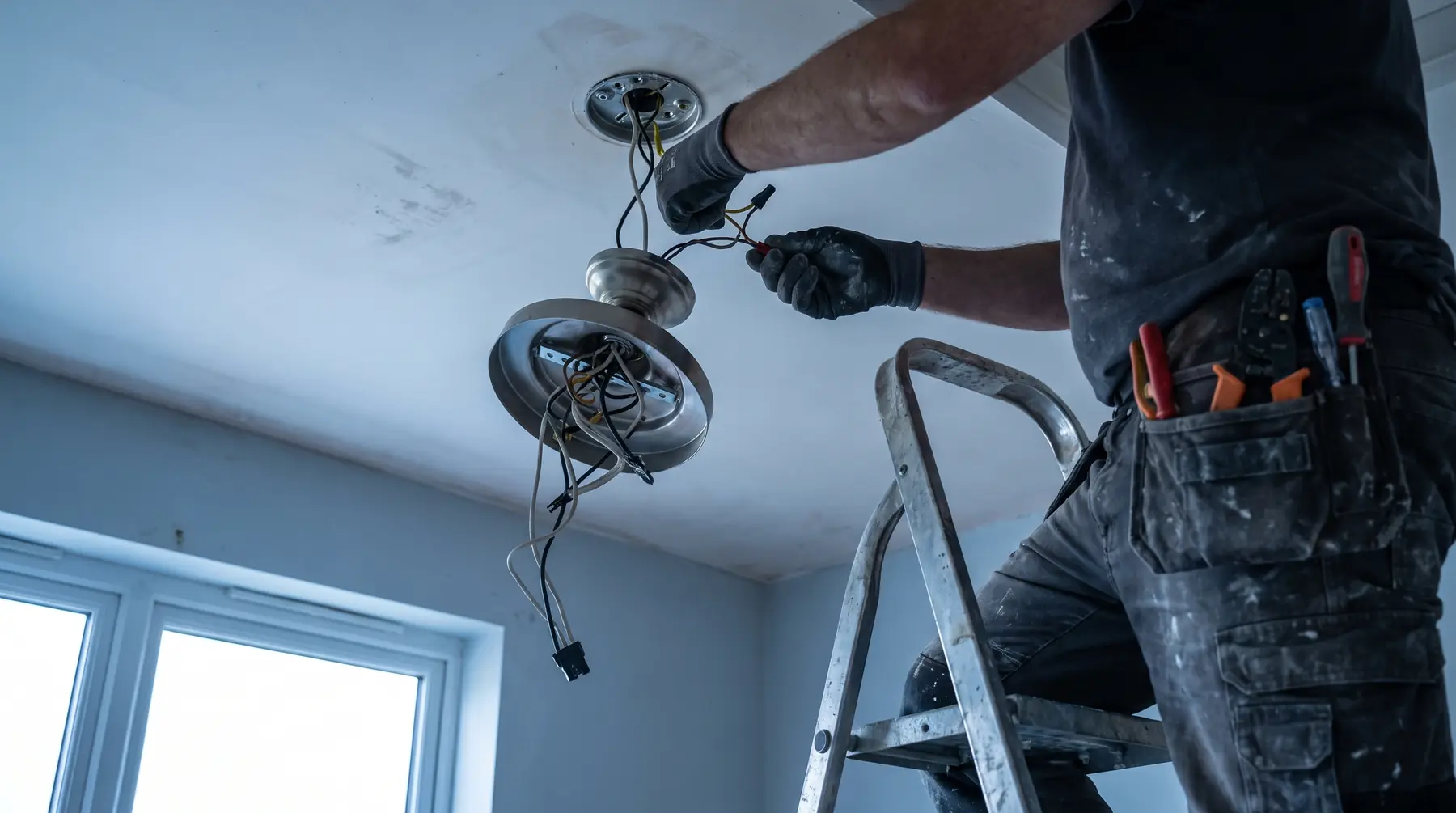
The second is the box in the ceiling, and it’s the single most common reason a fan install stops halfway. A fan has to hang from a box rated for fan support, fixed to framing or to a brace between joists. A plain lighting box will not do, however well the screws go in. In the 1960s apartment stock around here that’s what’s usually up there. The old fixture comes down and the box behind it needs replacing before anything else happens. In a single-story house with attic access it’s straightforward. In a second-floor unit with a neighbor above, it can mean opening a small patch of ceiling and repairing it after.
In the pre-war pockets you’ll sometimes find two wires and no ground at the box. There are correct ways to handle that, and a good pro tells you what they’ve found instead of twisting wires together and leaving. Old cloth-covered wiring or knob-and-tube is a stop-and-get-an-electrician moment.
The rest of the list around here
- Interior doors. Sixty years of settling does the same thing here it does everywhere: the door is still a rectangle, the opening isn’t. Rubbing at the top of the latch side usually means a sagged top hinge, not a door that needs planing.
- Fence and gate repair. Behind the corridors there are real yards and real gates. North of Victory toward Sun Valley, the blocks off Camarillo and Riverside Drive, the Whitsett side toward Valley Village. Gates take a beating.
- Faucets, toilets and disposals. Like-for-like swaps only. On anything built in the fifties or sixties that’s never been touched, expect the shut-off valve behind the fixture to be the surprise. It’s a cheap part that turns a one-hour job into two.
- Gutters. Rain season runs roughly October to March. The useful window to book is late September through October, not the first wet week of November.
- Weatherstripping, caulking and small carpentry. Trim, baseboards, cabinet doors that won’t sit square, and doors and windows that whistle.
Parking and access, which is not a small detail
On the apartment blocks along Chandler Boulevard, where the bike path runs, and around Lankershim, Magnolia, Cahuenga and Vineland, street parking is tight and the dingbats have tuck-under carports with every space spoken for. Someone arriving with a ladder, a miter saw or a toilet to haul out needs somewhere to put the van within carrying distance.
Tell us if there’s a gate, a subterranean garage with a height limit, an elevator, or a third-floor walk-up with no elevator at all. None of it is a dealbreaker. All of it changes how long the visit takes. Better in the notes than discovered at the curb.
What the license rule says
Most homeowners never get told this one. California has a minor work exemption, Business and Professions Code section 7048, that lets some small jobs be done without a CSLB contractor license. It’s narrower than people assume, and price is only part of it. The work has to be casual, minor or inconsequential. The whole contract price, labor and materials together, has to come to less than $1,000. The job can’t require a building permit, can’t be part of a larger project, and can’t be split into smaller contracts to get under the number. The exemption also drops away for someone who hires another person to help with the work, or who advertises in a way that might suggest to the public that they’re a contractor. So there’s no clean price line to go by.
Most of the work on this page is small work. Mounting a TV, patching a wall, swapping a faucet, hanging a fan, clearing gutters, putting a flat-pack together. Whether the exemption covers a particular person on a particular job turns on all of those conditions, not the price on its own, so it’s a fair question to put to any pro before they start. When a job clearly runs past small work it belongs with a licensed contractor or the right licensed trade, not the same person with a bigger invoice. And if a job grows once someone has seen it, the right move is to stop, say so, and re-price it before carrying on.
One wrinkle on fixture jobs: the price of the fixture counts toward that contract price, not just the labor. Buy the toilet or the faucet yourself and only the labor is in the total, which keeps the number down. Price is still only one of the conditions above.
What isn’t handyman work in North Hollywood
Saying no to things is more useful than claiming everything.
- Electrical past a fixture swap. New circuits, a switch moved to another wall, panel work. Licensed electrician.
- Plumbing past a like-for-like swap. Re-pipes, slab leaks, anything that opens a wall. Licensed plumber.
- Roofing, HVAC, structural work, permits, tree work and whole-unit repaints. Real trades, none of them a two-hour visit.
- Sanding or disturbing paint in anything built before 1978. That covers the pre-war bungalows and a lot of the postwar stock. Lead rules apply, and past six square feet of disturbed paint in a room the federal RRP rule wants a certified renovator using contained work practices. Not a handyman with a sander.
- A whole building’s worth of units at once. This is one-visit work. If you need forty turnovers inside a week, you need a crew and a schedule, and we’d rather say that now.
What to tell us
Tell us what’s on the list, add a photo if you have one, and include the cross streets and roughly when the building went up. That last one does more work than anything else on this page. The year tells us the wall, the wall tells us the anchors, and from there we know how long the visit runs. Send us the list and you’ll get a price back, usually the same day. We take lists around the clock.
Asking costs nothing, and nothing is added on top of the price you’re quoted. If the job sits outside this part of the Valley, we’ll say so, usually within a day, and tell you why.
You get a clear price before any work starts, and a straight answer if the job turns out to be bigger than it looked from the photo.
Where we work
The rest of Los Angeles County
What the walls are made of changes street by street in this city, and it changes the job.

Send us the list
However long it is. You get a price for the visit before anything is booked.