Skip to content
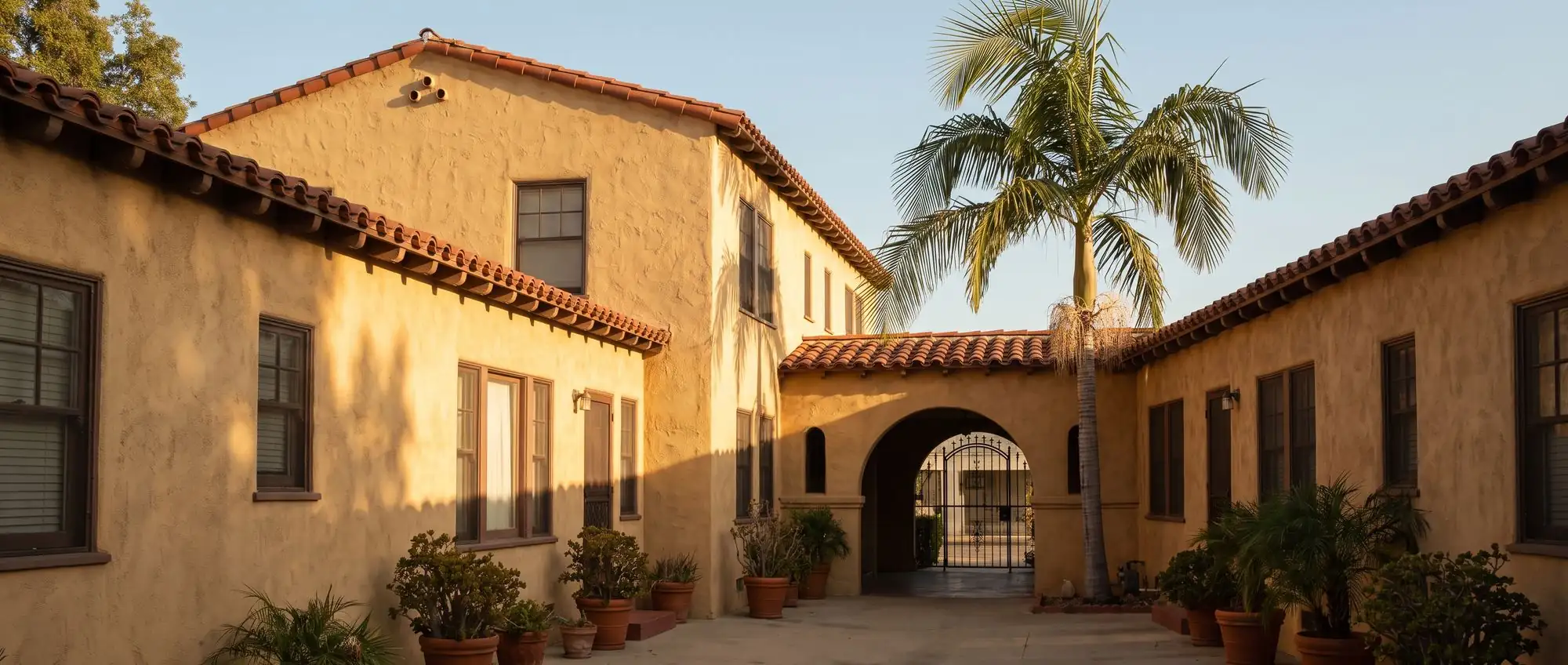
A 1920s Spanish-style stucco courtyard apartment building in Los Angeles

Los Angeles County, California

Small handyman jobs in Koreatown

Wilshire Center, the walk-ups on Serrano and Kenmore, the towers between Vermont and Western. Around 46,000 people to the square mile, and close to nine in ten of them renting. Which means the same short list of small jobs, over and over, in buildings that are nothing alike behind the paint.

Best priceguaranteed

Fastand reliable

24/7available

10+experienced handymen

Small repairs in Koreatown, in the buildings Koreatown is made of: plaster over wood lath in the pre-war walk-ups, drywall in the postwar stucco boxes, concrete and steel stud in the Wilshire towers. Three different walls behind one coat of paint, and three different jobs. Send the list and you get a price agreed before any work is scheduled.

Koreatown is the densest residential neighborhood in Los Angeles County. Somewhere around 46,000 people to the square mile, and about 89 percent of its roughly 31,700 occupied homes are rentals. Those two numbers shape most of the small-job work here. The same short list of jobs repeats thousands of times inside a few square miles, and we can fill a whole day without going further than a ten-block walk. That’s rare in this county, and it’s good for you, because a two-hour job in Koreatown is worth the trip in a way the same job in a spread-out part of the county often isn’t.

The buildings are the complicated part. Koreatown stacks three construction eras on top of each other, sometimes on the same block, so the wall you’re about to drill into may be nothing like the one across the street. A 1927 courtyard building off Ardmore, a 1961 stucco box in St. Andrews Square and a Wilshire Center tower are three separate jobs under similar paint.

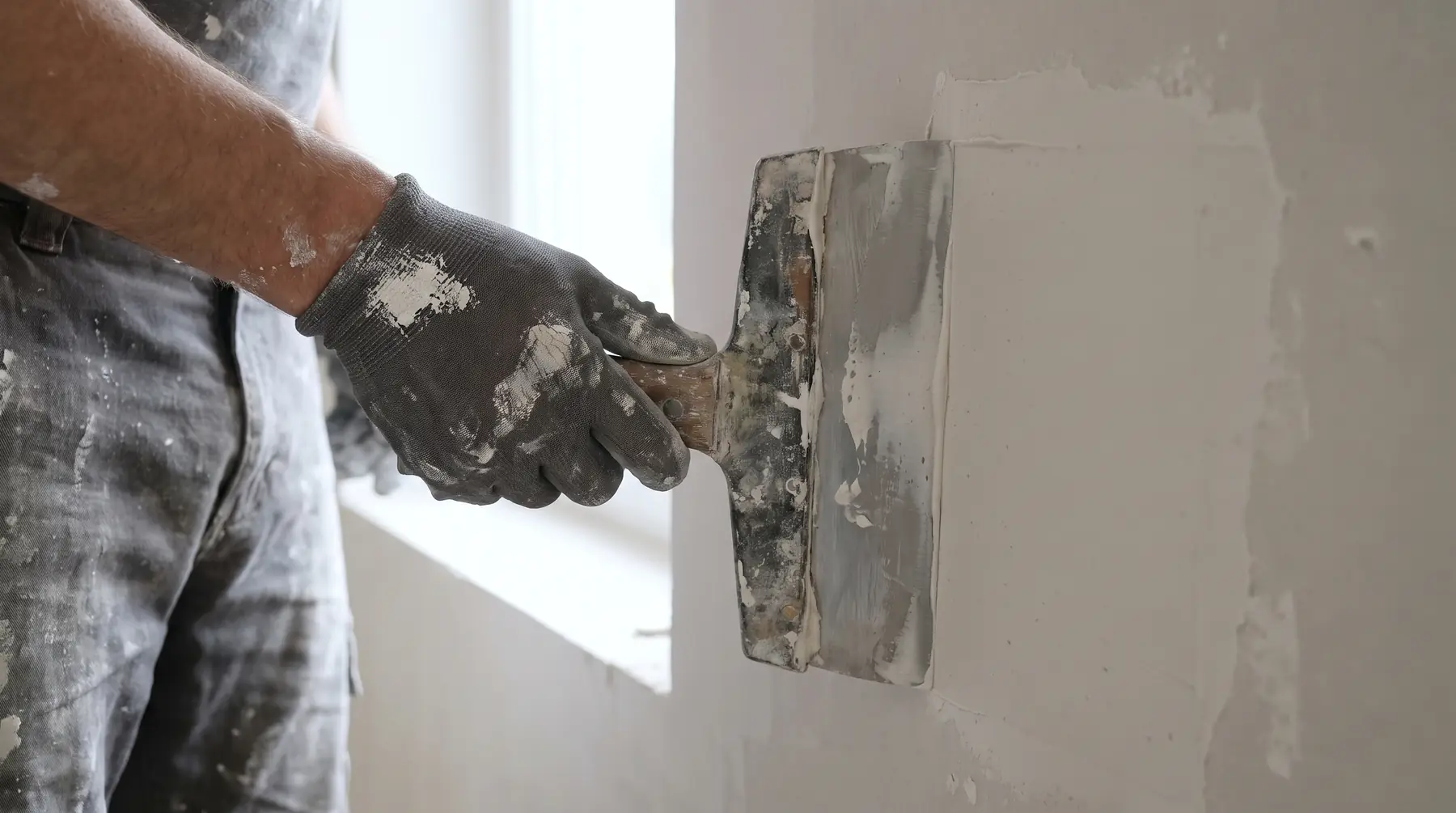
A taping knife drawing joint compound flat across a fresh patch
Pre-war stucco and courtyard buildings are plaster over lath. Patching it is slower than drywall and it will not take an anchor meant for drywall.

The detail below is here if you want it. You do not need any of it to send us a job.

Three kinds of building, three different walls

The 1920s and 1930s stock, which is about a third of the neighborhood

Roughly 29 percent of homes here predate 1940, with another 5 percent going up before 1950. That’s the Spanish Revival and Art Deco courtyard buildings, the four- to twelve-unit walk-ups on Serrano, Kenmore, Ardmore, Harvard and Mariposa, and the grand pre-war towers along Wilshire. Beautiful stock. Also the fussiest walls in the city.

Behind the paint is plaster over wood lath, not drywall. It’s harder, thicker and more brittle, it blows out in a cone if someone drives a screw into it in a hurry, and the lath holds nothing on its own. Studs sit at irregular spacings, and the old full-dimension lumber reads badly on a cheap stud finder, which is how a bracket ends up anchored to nothing. We go looking for real framing instead of trusting a beep, and we’ll often span two studs with a longer plate. There’s more on that on the TV mounting page.

The same buildings settle. Frames that were square in 1929 aren’t square now, which is why interior doors in these units stick at the top of the latch side or need a shove to catch. Planing the door is usually the wrong first move. The door repair page explains what to look at first. Patching plaster with drywall compound alone tends to crack again within a year, because the plaster around it keeps moving. Plaster repair is a different job from drywall repair, and we tell you that up front.

The postwar stucco boxes and dingbats

Through the 1950s, 60s and 70s, bungalow lots across Koreatown came down and stucco apartment boxes went up on them, plenty of them dingbats with parking tucked underneath. You see them everywhere between St. Andrews Square and the Harvard Heights and Pico-Union edges. These are the easy ones. Drywall over wood studs, standard spacings, a mount or a patch that behaves the way the internet says it should. If you live in one of these, most of the menu is straightforward and can be priced over the phone.

Wilshire Center: the towers and podium buildings

Along the high-rise stretch of Wilshire between Vermont and Western, and in the podium buildings that have gone up along Western and Vermont since the nineties, you’re usually looking at concrete with metal-stud partitions. Nothing wrong with that, but it’s a different anchor, and the wrong anchor in a steel stud is one of the most common reasons a mount works loose a year later. Concrete needs the right bit and the right sleeve. Tell us which kind of building you’re in when you send the job over. It changes the anchors, the tools and how long the visit takes.

Renting, owning, or turning a unit over

Nine out of ten households here rent. The owner-occupied pockets are small: the pre-war single-family blocks on the Windsor and Country Club Park edges, and a band of condos along Wilshire. So most jobs in Koreatown come from one of three people, and each one wants something a little different.

  • Tenants. Get your landlord’s or manager’s sign-off before anything goes into a wall, especially a TV mount or a curtain rail. Say in your message that you’re renting, so we know to keep the work reversible and can talk you through what patching would cost at move-out.
  • Owners in the Wilshire condos. Your building likely has rules about work hours, elevator use and insurance. Mention the HOA when you get in touch. It holds nothing up. It just books differently.
  • Landlords and unit managers. Under the City of LA’s rent stabilization ordinance, any building of two or more units with a certificate of occupancy on or before October 1, 1978 is covered. That describes most of the apartment stock in Koreatown, so the turnover work is steady: a wall of anchor holes filled, a doorknob-sized hole patched and textured, one room painted, a tired faucet swapped before the next tenant walks in. Say you’re turning a unit when you get in touch. One careful install in an occupied home and a fast whole-unit punch list are two different days of work, and they get priced differently.

Either way, check early whether the building wants written permission or a certificate of insurance before anyone turns up. Sorting that out ahead of the visit saves everybody a wasted trip.

Parking, access, and why jobs get batched here

Almost nothing in Koreatown has a driveway. It’s permit blocks, meters, and circling. Turning up with a ladder, a hammer drill and a bag of anchors takes real time before anything gets touched. That’s why a single nail hole is a hard thing to book anywhere, and harder here.

So batch it. Walk the apartment and write down everything: the TV, the two curtain rails, the mirror in the hallway, the bathroom door that won’t latch, the anchor holes from the last tenant. Send it as one job. One visit, one price, and it stops being an awkward ask.

Building access is the other thing. If the manager holds the only key to the roof, the garage or the electrical room, tell us. And if you’re in one of the towers, the loading elevator often has to be booked. None of it is complicated. It just decides whether a visit happens or gets moved.

The jobs that come up most around here

  • TV mounting and wall shelving. The most common ask in dense rental housing, and the one most affected by whether you’ve got plaster, drywall or steel stud behind you.
  • Picture, mirror and curtain hanging. Apartment work, over and over. Heavy mirrors in plaster are their own small problem.
  • Drywall and plaster repair. Anchor holes in a batch, doorknob holes, hairline cracking in the pre-war units. Filling is the quick part. Matching the texture is what takes the time.
  • Interior door repair and adjustment. Settled frames, latches an eighth of an inch out, closet bifolds that jumped their track.
  • Faucet, toilet and disposal swaps. Like-for-like only. In buildings this old, expect the angle stop behind the fixture to be seized. It’s the single most common surprise on older LA plumbing, and we carry the valve.
  • Ceiling fans and light fixtures. Fixture swaps where a box and wiring already exist. In pre-war units it’s common to find two wires and no ground, and old cloth wiring or knob-and-tube is a stop-and-call-an-electrician moment.
  • Furniture and flat-pack assembly, weatherstripping and caulking, small painting. Draft-proofing and sealing get asked for more here than people expect, mostly because of street dust and traffic noise on the bigger corridors.
  • Squeaky floors, loose boards and lifting plank. In a stacked building the underside of your floor is someone else’s ceiling, so a squeak in a pre-war walk-up gets fixed from above, screwed through the oak strip into the joist and plugged. Turnover units are the other half of it: plank laid over an old floor lifts at the seams, and transition strips at doorways work loose. If a pre-1978 kitchen or bath still has 9x9 tile, say so and stop there, because the black adhesive under it is an asbestos suspect and belongs to a testing and abatement outfit.
  • Grab bars, handrails and alarms. A grab bar has to catch framing, and in a pre-war bathroom that means drilling mud-set tile over a mortar bed with irregular studs behind it, $325-$650 against the $225-$450 a first bar costs on an ordinary wall. If you rent, get the sign-off first, same as any other hole. The turnover list is the other side of it: smoke alarms, CO alarms in units with a gas appliance or an attached garage, and the water heater strapping California requires against earthquake movement.

Gutter clearing is the odd one out in Koreatown. If you own one of the houses on the Windsor or Country Club Park edges, or a low-rise building where the roofline is yours, book it from late September through October, not in the middle of the first storm. If you’re a tenant three floors up, gutters are the building’s problem and not yours.

A third of the neighborhood predates 1940, so lead comes up constantly

Homes built before 1978 may have lead-based paint, and in this part of LA that’s most of the housing. For work that disturbs painted surfaces, the federal RRP rule requires a certified renovator using contained work practices once the job disturbs more than six square feet of painted surface in a room, or twenty outside. Sanding old paint on a door and jamb, or cutting into a painted plaster wall for a patch, is the kind of work that triggers it. Tell us how old the building is when you send the job in. On a pre-1940 building that patch needs plastic, containment and a proper cleanup instead of a sander and good intentions, and that changes both the time and the price.

When a job needs a licensed contractor

In California, some small jobs fall under a minor work exemption from contractor licensing, Business and Professions Code section 7048. It’s narrower than most people assume, and every part of it has to be true at once: the work is casual, minor or inconsequential in nature; the total price for labor, materials and everything else comes to less than $1,000; the job doesn’t require a building permit; and it isn’t one piece of a larger project, or a bigger job chopped into smaller contracts to stay under the number. The exemption also doesn’t cover anyone who advertises in a way that might suggest to the public they’re a contractor, or who employs another person to do the work or help with it. If any one of those doesn’t hold, the work needs a licensed contractor. There’s no single price line to go by.

Most of the jobs above are small enough to be in that range, but price is only one of the conditions. A cheap job that needs a permit, or that’s one part of a bigger remodel, sits outside the exemption anyway. Some Koreatown jobs are plainly past it: a whole unit repainted between tenants, several doors replaced at once, a run of gutter replaced instead of resealed. When a job runs past what that exemption covers, it needs a licensed contractor on it, and we’ll say so before anyone starts. On fixture swaps, remember the fixture price counts toward the total, so buying the toilet or faucet yourself is often what keeps a job under $1,000. And if the work grows once we’ve seen it, we stop, tell you what changed, and nothing goes further until you’ve agreed the new price. Knowing where that exemption stops before the first hole gets drilled is worth more to you than any badge on a website.

What we won’t take on in Koreatown

Saying no to things is more useful than claiming everything.

  • Electrical past a fixture swap. New circuits, a new outlet behind the TV, panel work, anything in an old building with scorching or a breaker that keeps tripping. Licensed electrician.
  • Plumbing past a like-for-like swap. In a stacked apartment building, opening a wall or touching a shared line is not a handyman job and usually isn’t yours to authorize either.
  • Roofing, structural work, permits, HVAC and whole-building repaints. Real trades, none of them a two-hour visit.
  • Building-wide maintenance contracts. This is single-visit work: one home, one list, one price. Standing maintenance across a portfolio of buildings is a different arrangement, and not something we do.

If your job is on that list, send it anyway and say so. Pointing you at the right trade is more use to you than taking on work that belongs to someone else. And if it isn’t something that can be covered in your part of Koreatown, you’ll hear back within about a day with the reason, same as anywhere else in the county.

What to tell us when you get in touch

  • Your cross streets. Serrano and Sixth and Wilshire and Western are a mile apart and nothing alike behind the walls. The block matters more than the city name.
  • Roughly when the building went up, or just what it looks like: pre-war courtyard, stucco box, or tower.
  • What the wall is, if you know: plaster, drywall, concrete, steel stud. Not sure is a fine answer.
  • Whether you rent, own, or manage the unit, and whether there’s an HOA, a landlord or a building manager who needs to approve the work.
  • Parking and access, including whether the elevator needs booking.
  • A photo. It saves more back-and-forth than anything you can type.

That’s enough to price the visit properly. Send us the list and you get a clear price before any work starts, and nothing gets scheduled until you’ve agreed to it. For more detail on what a visit looks like from the first call to the last hole filled, see the how it works page.

Where we work

The rest of Los Angeles County

What the walls are made of changes street by street in this city, and it changes the job.

Send us the list

However long it is. You get a price for the visit before anything is booked.

Send the listCall